

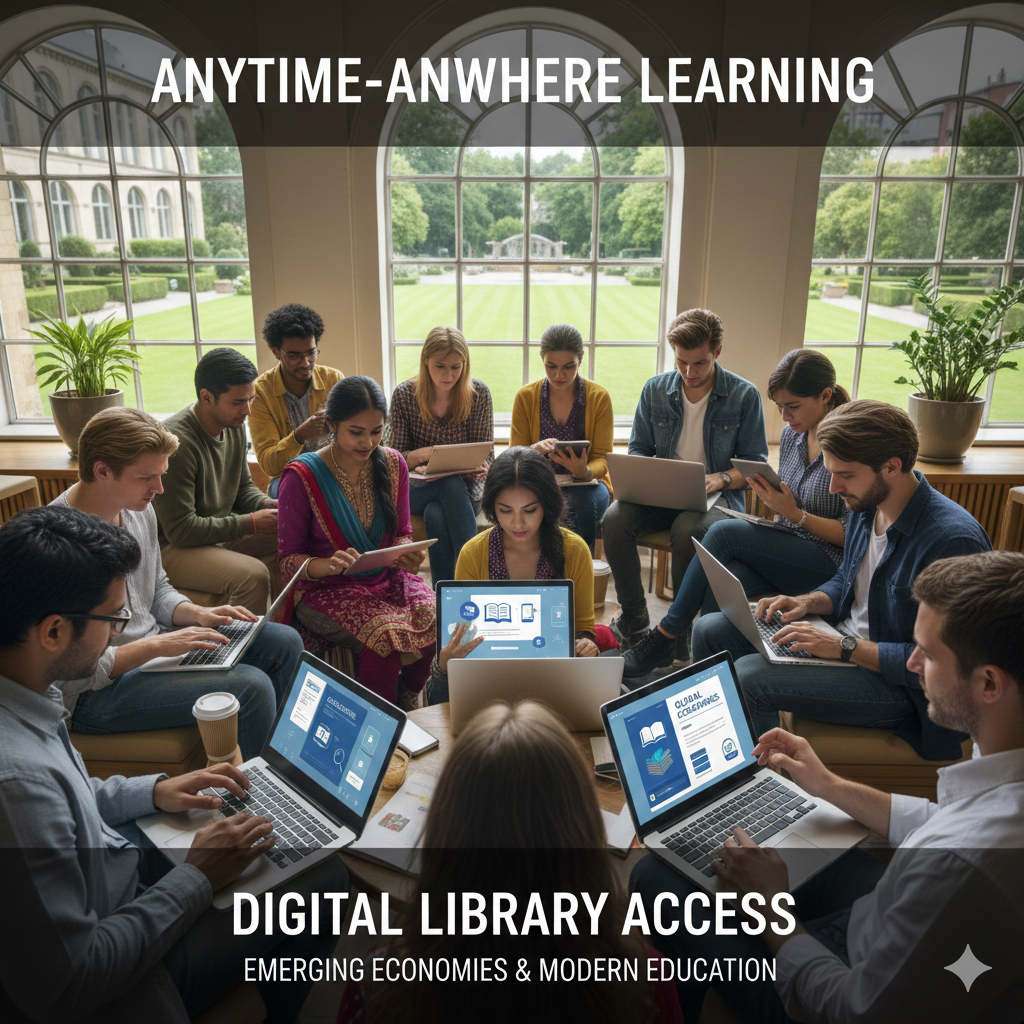
The education system in emerging economies is at a crossroads. The challenge facing the traditional teaching models is evident in rapid population increase, insufficiency in infrastructure, the increase in textbook prices, and inaccessible quality learning facilities. Simultaneously, the digital transformation is making mighty possibilities to fill these gaps. The Digital Library is one of the solutions that is both effective and scalable.
A Digital Library is no longer an option that is nice to have in the education system. It has taken a critical role and foundation towards inclusive, affordable, and future-ready learning, particularly in emerging economies where access and equity are central issues.
The Reality of Education Systems in Emerging Economies
Similar problems occur with many education systems in the developing regions:
- Lack of modernised textbooks and reference books
- Expenses are high in terms of printing and physical distribution
- Poor library facilities, particularly in rural locations
- Inequalities in access to quality academic resources
- Absence of exposure to international research and journals, as well as online content
Although students are becoming well accustomed to smartphones and the web, learning institutions usually find it hard to translate this digital exposure into a format that is organized and substantive learning. Here, a properly developed Digital Library is revolutionary.
What Makes a Digital Library So Powerful?
A Digital Library is a monolithic online system that makes available academic books, journals, research papers, multimedia content, institutional resources, and learning materials-24/7/365 anywhere you are.
Digital libraries, in contrast to traditional ones, do not have any limitations based on physical space, limited copies, or the time of operation. In the case of emerging economies, this flexibility would be a direct response to the long-term obstacles in the education system.
1. Democratizing Access to Knowledge
Equal access is one of the greatest benefits of a Digital Library. The connection with the internet helps urban city students and remote village students to have the same high-quality academic resources.
This knowledge democratization assists in diminishing inequality in education and eliminates geographical and institutional budget restraints to access to education. This is a game-changer for the emerging economies that seek to have stronger education systems.
2. Cost-Effective and Scalable Learning Infrastructure.
The construction and upkeep of physical libraries is costly. Procurement, storage, updates, and maintenance need constant investment. These costs greatly decrease because of digital libraries.
A Digital Library can be extended to many institutions, departments, or campuses once installed, without the need to repeat physical expenditure. This is why it is the best option for governments, universities, and schools with limited budgets but with high student populations.
3. Supporting Modern Learning Styles
The current generation of learners enjoys interactive, visual, and on-demand content. A Digital Library supports:
- E-books and audiobooks
- Videos and presentations
- Journals and research
- Archives and institutional
It is completely in line with blended learning, distance learning, and self-paced learning models that are taking up vital roles in the contemporary education system.
Empowering Research and Academic Quality.

The developing economies are giving more and more emphasis on the quality of academics and global competitiveness. Digital libraries are very crucial in this mission.
4. Easy Access to Research and Global Knowledge
Professors and researchers tend to find it difficult to access foreign journals and current research. A Digital Library is a combination of several sources of content on a single platform, providing an opportunity to access all the academic resources worldwide with ease.
This promotes learning that is based on research, increases the productivity of the faculty, and assists the institutions in fulfilling accreditation and quality standards.
5. Promoting Lifelong Learning.
Education is no longer a graduation process. Digital libraries assist in lifelong learning as it allows students, teachers, and others to access updated information at all times.
Such a lifelong learning culture is necessary in a changing education system regarding workforce preparedness and national development.
Digital Libraries and the Future of Education Systems
With the transition of education systems to the digital-first mode, the task of digital libraries becomes even more urgent.
- Favors distance and hybrid
- Guarantees continuity in academics in cases of
- Allows the data-driven understanding of the resource
- Improves institutional
To the developing economies, the introduction of Digital Library platforms is not merely a technological matter, but rather creating strong, inclusive education systems that can embrace change.
How Mintbook Empowers Digital Libraries in Education
Mintbook is aware of the special issues of the emerging economy education systems. Its Digital Library solutions are scalable, user-friendly, and flexible, and this makes digital transformation practical and possible for all institutions, big or small.
Key Benefits of Mintbook’s Digital Library Solutions
- Books, journals, research papers, and multimedia Centralized content
- Streamlined access to students, faculty, and
- Specialised platforms that could be tailored according to institutional
- Distributed architecture based on reliability and scalability on the
- Insight and analytics to monitor usage and resource
Mintbook enables institutions to enhance the learning outcome by making access to academic material easier and simplifying the operational process.
Building Inclusive and Future-Ready Education Systems

Mintbook technological services are not just limited to technology. They assist institutions in developing a digital ecosystem through which knowledge is available, structured, and constantly changing. It may be a school, college, university, or training institute, but either way, Mintbook helps education systems to shift away, past the traditional constraints, into the digital opportunities.
Conclusion
The future of education in the case of the emerging economies lies in its accessibility, affordability, and flexibility. Digital Libraries are the center of this revolution as they enable students, teachers, and institutions to have unlimited knowledge.
Through the introduction of Digital Library solutions such as those provided by Mintbook, the education systems will be able to overcome the obstacles of resources, improve the quality of academic processes, and equip the learners to operate in the digital-first world. In the age of information, digital libraries are not only essential but also the cornerstone of education and national development.
