

The manner in which institutions teach, train, and interact with the learners has transformed tremendously. Be it a school, college, university, or a training institute, digital learning is no longer a choice, but a necessity. The core of this change is the possibility to make one decision: to pick the appropriate LMS.
However, in a world where dozens of platforms purport to be all-in-one, AI-powered, and future-ready, how do you ever make the correct decision? This guide is a practical dissection of the software selection process in LMS in a simpler and more easily comprehensible manner- and demonstrates how Mintbook can find a place in the contemporary educational ecosystem.
Why Choosing the Right LMS Matters More Than Ever
A Learning Management System is not only a content uploading tool. It will be the lifeline of your educational processes- it will affect students, professors, administrators, and even parents.
The right LMS can:
- Improve learner engagement
- Streamline the academic
- Promote distance and distance
- Offer evidence-based information to make improvements
On the other hand, the ineffective LMS will result in poor adoption, annoyed faculty, bored students, and squandered budgets. This is why it is necessary to select LMS platforms.
Step 1: Understand Your Institution’s Real Needs
Before leaping into an LMS comparison, ask:
- Is it K-12, higher education, or professional training that you are serving?
- Do you require online, offline, or blended lectures?
- How technologically minded are your faculty and undergraduates?
- Do you require integration with admissions, attendance, exams, or fee management?
The failure of many institutions with LMS software selection is related to the fact that they concentrate on those features that they may use rather than what they need in terms of capability.
This is the place that tools such as Mintbook come into play, utilizing LMS with a robust Student Information System (SIS), eliminating the necessity to use several tools not connected to each other.
Step 2: Focus on User Experience, Not Just Features
An LMS with all features will not help anyone, unless he/she likes it. The evaluation of LMS software should include:
- Is the interface students and teacher-friendly?
- How simple is the creation of content and management of the course?
- Is it compatible with mobile phones?
- Is it possible that faculty can change without having years of training?
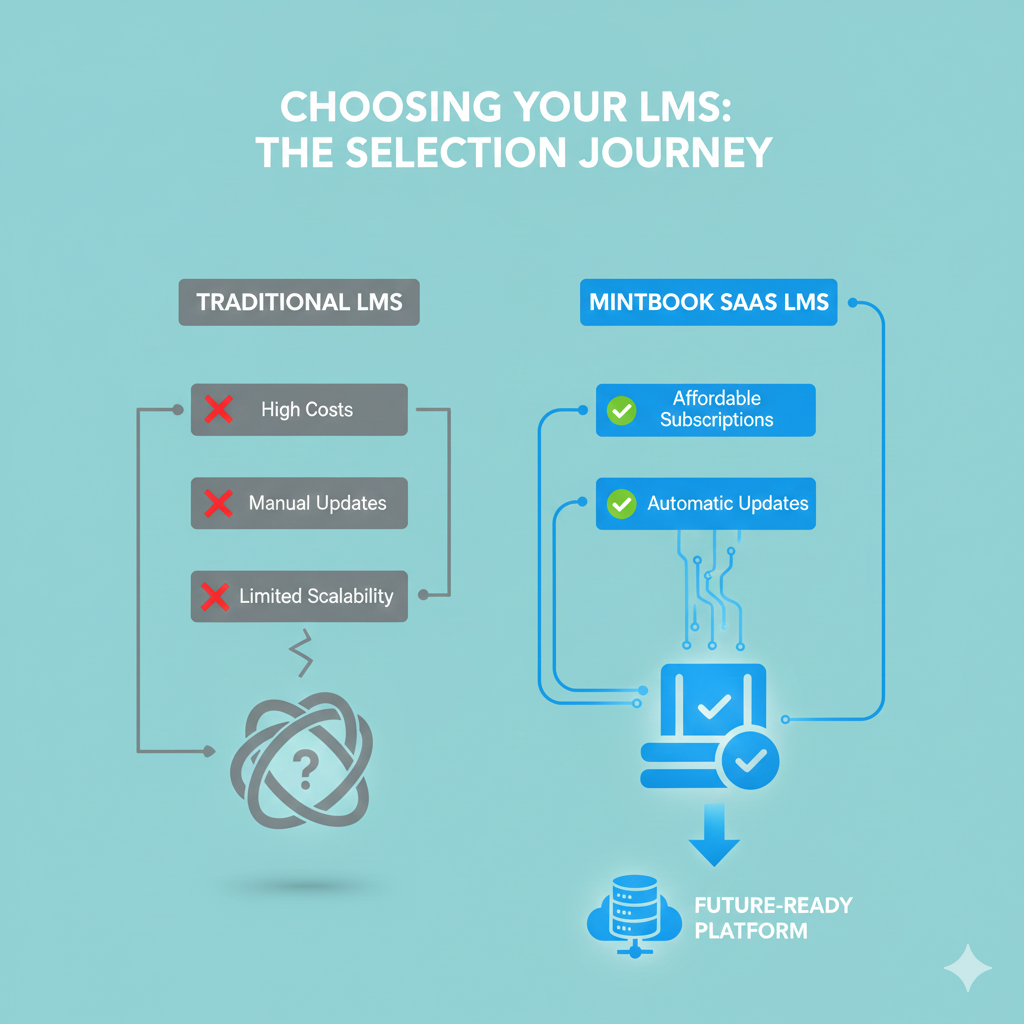
Mintbook is a product that has simplicity and usability as its core. The faculty will be in a position to post material, give tests, track progress, and communicate with the learners without the technical skills. The students get a learning environment free of distraction and cross-device compatible.
Step 3: Evaluate Content Delivery & Assessment Capabilities
Contemporary learning is participative and not passive. Your LMS should support:
- Videotaped lectures and video
- Exam, assignments,
- Discussion forums and announcements
- Tracking of progress and
When comparing LMS, consider how well the platform facilitated a synchronous and asynchronous learning.
The LMS provided by Mintbook provides institutions with the capability to deliver high-quality content, administer assessments, and track the progress of learners in real-time, ensuring that the results of teaching meet the academic objectives.
Step 4: Integration Is a Game Changer
The major problem that institutions have encountered is that the various systems, which include LMS, admissions, attendance, exams, finance, and communication tools, run independently.
This leads to:
- Duplicate data entry
- Errors and inconsistencies
- Higher operational costs
Mintbook addresses this by having an integrated ecosystem. Its LMS can easily be linked to its SIS modules, including:
- Life cycle management of
- Attendance tracking
- Examination and grading
- Along with communication to students and
Such integration can be very helpful in relieving the workload of administration when selecting LMS platforms.
Step 5: Data, Analytics & Decision-Making.
An LMS must not only be able to deliver content, but it must also assist the institutions in making smarter decisions.
Look for:
- Student engagement reports
- Course completion rates
- Performance analytics
- Insights about faculty
Mintbook also offers actionable dashboards that allow administrators and educators to have a good understanding of what is working and what requires enhancements. This data-first methodology makes learning a process that can be measured and improved.
Step 6: Scalability, Security, and Compliance.
With the expansion of your institution, your LMS should expand.
The major considerations in the selection of LMS software are:
- Scaling user and course
- Security of data and role
- Adherence to organizational
- Cloud-based reliability
Mintbook is made to accommodate both single-campus institutions and those with a multi-institution network without being security- or performance-starved.
Step 7: Support, Training, and long-term partnership.
Technology does not ensure success in itself. The right LMS provider is not a one-time vendor, but a long-term partner.
In selecting LMS solutions, pose the following questions:
- Is training and onboarding involved?
- Response to customer service is how responsive?
- Has the platform changed according to the changing education requirements?

Mintbook provides 24/7 support, frequent releases, and a product roadmap informed by actual institutional feedback- your LMS will remain relevant as time goes on.
Why Mintbook Is a Smart Choice for Modern Institutions
Mintbook will be able to distinguish itself in an overcrowded LMS marketplace by providing:
- A unified LMS + SIS platform
- Easy-to-use design for all
- Good analytics and
- Smartness in the integration of the academic
Mintbook provides one source of learning and administration instead of having to manage multiple systems in the institution.
Final Thoughts
The decision on the appropriate LMS does not consist of choosing the most popular tool, but rather one that fits your organization, working processes, and students.
The consideration of an LMS comparative study, coupled with prioritization, will change the outcome of teaching and learning. Combining an integrated design, user-friendliness, and institution-centric design, Mintbook simplifies decision-making when it comes to selecting LMS solutions, which is smarter and more sustainable.
When your institution is ready to stop relying on disjointed systems and enter into an interconnected digital learning landscape, Mintbook is designed to help you do so, today and tomorrow.
