

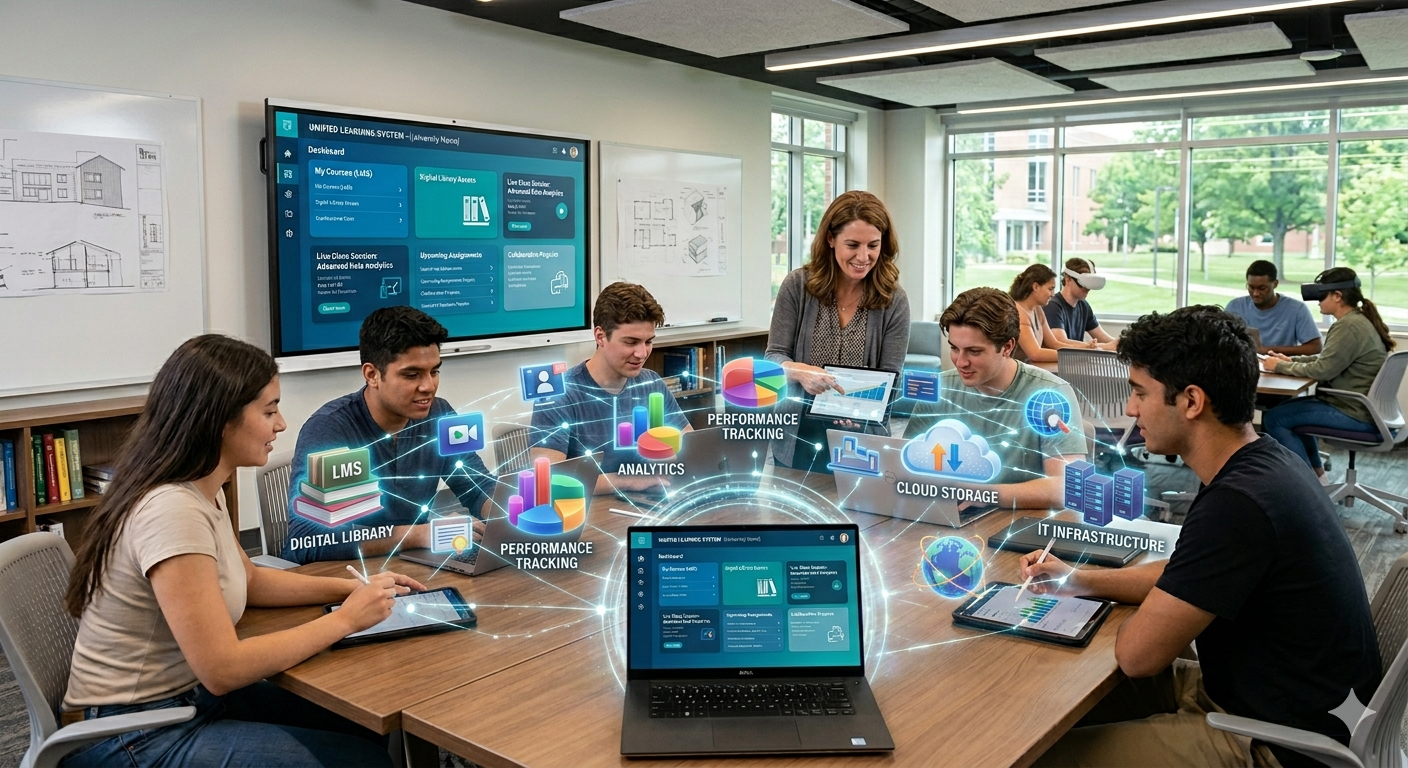
The fast-paced development of education has placed institutions at a very critical junction- the selection of the appropriate Digital Learning Infrastructure. As the need to achieve smooth, interactive, and result-focused education rises, institutions tend to have a three-fold dilemma between Digital Library, Learning Management System (LMS), and a Unified Learning System.
Although both have a purpose, the real question is: which is the one that really suits the needs of the modern learner and educator?
And we will make it practical, humanly.
Understanding the Basics
It is worth knowing what each system entails before making a selection.
Digital Library: The Content Hub
A Digital Library is simply a collection of learning materials. Imagine it as a virtual bookshelf that has eBooks, videos, journals, and other learning materials in a well-organized manner.
What it does well:
- Offers convenient access to extensive information on education.
- Supports self-paced learning
- Promotes reading and researching.
Where it is lacking:
- Lacks designed learning tracks.
- No monitoring of student progress.
- Little interaction or engagement tools.
To put it briefly, a Digital Library is very good in terms of access, but not in terms of learning management.
LMS (Learning Management System): The Learning Organizer
LMS is an addition to content with structure. It enables instructors to develop courses, set assignments, monitor progress, and conduct assessments.
What it does well:
- Arranges courses and modules.
- Measures student performance and completion.
- Enables assessments and feedback
Limitations:
- Content dependency (requires external sources of content)
- May be stiff or complicated.
- Poor interconnectedness with larger learning environments.
LMS is excellent for handling learning, yet it is often not so rich in content or flexible.
Unified Learning System: The Complete Ecosystem
A Unified Learning System unites the merits of a Digital Library and LMS- and goes even further. It integrates content, delivery, engagement, analytics, and administration into a single platform.
What it does well:
- Integrates course management + content.
- Provides individual learning experiences.
- Learns in real-time.
- Improves teamwork and interaction.
- Lessens the necessity of numerous platforms.
This strategy transforms institutions into integrated Digital Learning eco-systems.
Why the Choice Matters More Than Ever
In today’s education landscape, learners expect more than just access to content. They expect:
- Interactive and exciting experiences.
- Personalized learning paths
- Measurable outcomes
- Anytime, anywhere access
The existence of a disintegrated system, where content, assessments, and tracking are separate, creates gaps. Such gaps affect administrative efficiency and the performance of students.
That is why institutions are gravitating towards an integrated Digital Learning Infrastructure as opposed to isolated solutions.
Digital Library vs LMS vs Unified Platform: A Quick Comparison
| Feature | Digital Library | LMS | Unified Learning System |
| Content Access | ✔️ | Limited | ✔️✔️ |
| Course Management | ❌ | ✔️ | ✔️✔️ |
| Learning Analytics | ❌ | ✔️ | ✔️✔️ |
| Engagement Tools | ❌ | Limited | ✔️✔️ |
| Integration | ❌ | Limited | ✔️✔️ |
| Scalability | Moderate | Moderate | High |
The trend is evident: LMS platforms and Digital Libraries are silos, even though they perform certain functions. A Unified Learning System eradicates these silos.

The Real Challenge Institutions Face
A combination of tools is used today in many institutions:
- A single content platform.
- Another for assessments
- One third to speak.
This creates:
- Data fragmentation
- Higher operational costs
- Poor user experience
Faculty find it hard to deal with various systems. Students feel disconnected. Administrators do not have clear insights.
The result? Learning outcomes suffer.
Why a Unified Learning System is the Future
ULS is no mere trend; it is a necessity.
The following are the reasons why institutions are shifting:
Seamless Learning Experience
Students don’t have to jump between platforms. All the content and assessments are located in a single place.
Data-Driven Decisions
Live analytics can help teachers see what is and is not working.
Improved Learning Outcomes
Formatted material + interaction + monitoring results in improved outcomes.
Cost Efficiency
A single platform saves on licensing, maintenance, and training expenses.
Scalability for Growth
Be it 100 students or 10,000, a cohesive system expands with the institution.
Where Mintbook Fits In
This is where Mintbook can be seen as a game-changer in the education field.
Mintbook provides an effective Unified Learning System integrating:
- A rich Digital Library with curated and curriculum-aligned content
- State-of-the-art course management and assessment in LMS.
- Artificial intelligence-based information to monitor and enhance learning results.
- Uninterrupted integration towards a strong Digital Learning Infrastructure.
Mintbook provides institutions with the best of both and more- instead of having to decide between a Digital Library or LMS.

What Makes Mintbook Different?
Content + Technology in One Platform
No need to source content separately. Mintbook offers a complete Digital Library as part of the system.
Designed for Indian Education Needs
In line with changing academic models and online programs.
Easy to Use
Easy to use interface, both teachers and learners- no learning curve.
Focus on Learning Outcomes
It is not only about content delivery but also about making sure that the students are learning.
Making the Right Choice.
A Digital Library can be sufficient, in case your institution is simply seeking to access the content.
An LMS is a step in the right direction if you desire a structured course delivery and tracking.
However, a Unified Learning System is the most intelligent option, should you want to have a future-ready, scalable, and effective Digital Learning Infrastructure.
Final Thoughts
Education is no longer about teaching- it is now about organizing significant learning experiences. The institutions selected now will define the degree to which they will provide those experiences in the future.
Short-term fragmentation can be effective in the short term, but it will not grow and deliver results in the long term.
With a Unified Learning System such as that provided by Mintbook, it is certain that the institutions are not simply keeping up, but are ahead in Digital Learning.
Call to Action
Ready to transform your institution’s learning experience?
Learn how the Unified Learning System of Mintbook can reinvent your Digital Learning Infrastructure- uniting content, technology, and results in a single platform of powerful results.
Get acquainted with Mintbook now and start the journey to smart, more effective education.
