

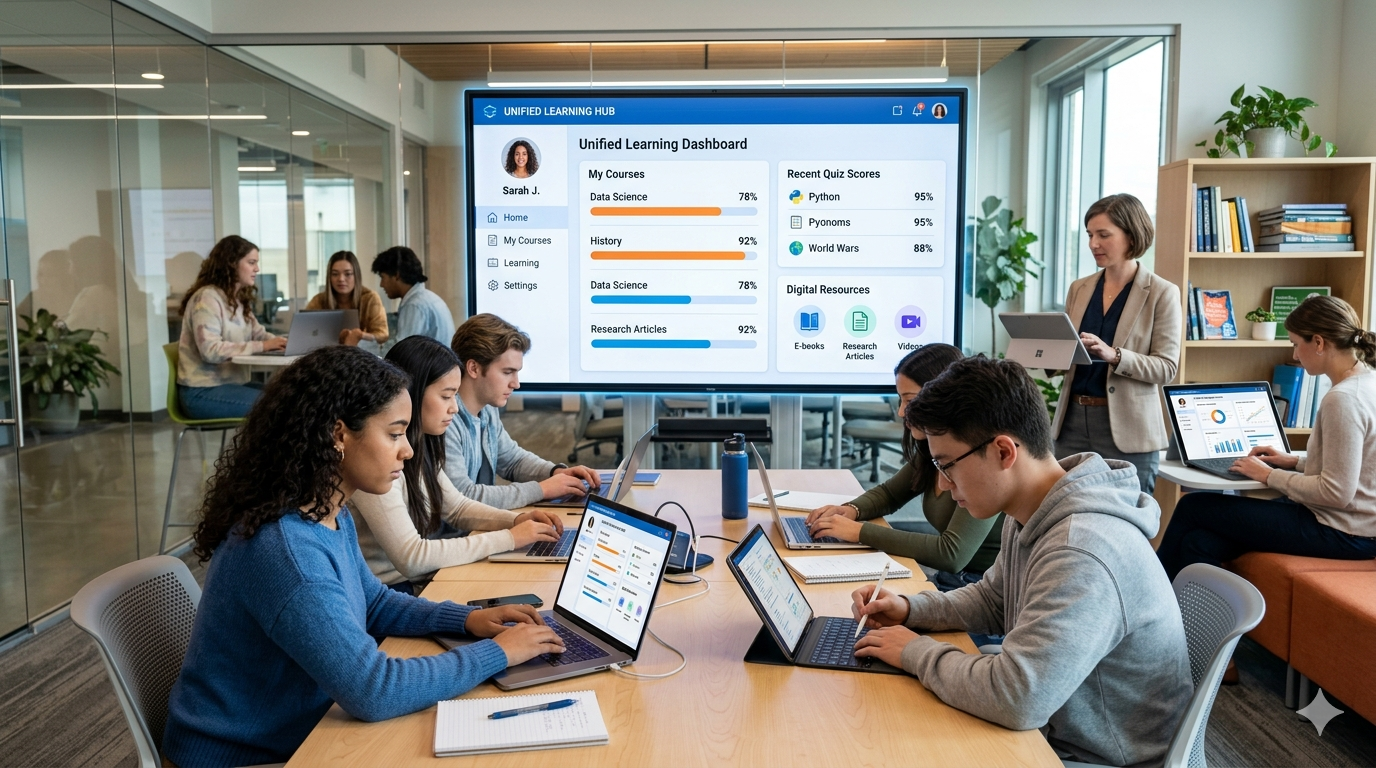
In the current dynamically changing education environment, accessibility of the content is no longer the largest issue; completion and understanding of it is. Learning institutions and schools have placed a lot of investment in digital tools, particularly the LMS System, to facilitate coursework and monitoring of progress. However, with such investments, a significant question that remains on the minds of many educators is: Are students learning, or are they consuming?
It is at this point that the idea of a Unified Learning System comes into play. By closing the gaps between content, interaction, and assessment, integrated platforms are changing the way education is provided-and more crucially, how Learning Outcomes are attained.
The Problem with Fragmented Learning Systems
Conventional online learning systems tend to be siloed. An average institution could use:
- A grading and assignments LMS System.
- An independent Digital Library to access content.
- Additional tools for assessments or communication
Although each of the tools has its purpose, the integration is lacking and generates tension on both sides: among students and teachers. Students might be confused at the point of cross-platforming, and teachers might not be able to keep up with holistic progress.
This disintegration results in:
- Reduced engagement
- Inconsistent learning experiences
- Reduced completion of courses.
- Poor transparency of real learning outcomes.
Concisely, access to content does not necessarily equate to learning success.

From Access to Achievement: The Role of Unified Platforms
With a Unified Learning System, it is all integrated: content, delivery, assessment, analytics, all in one seamless ecosystem. Students and teachers do not have to play with multiple tools, but rather communicate in a single, unified space.
Unified platforms will transform content consumers into course completers in the following manner:
Seamless Content Integration
A single platform combines an enriched Digital Library into the learning process. Students no longer have to browse multiple sources to find that material; they can find content that is curated and aligned with the curriculum as they study and do their assignments.
This ensures:
- Accessibility to pertinent materials.
- Reduced cognitive overload
- Improved attention to learning goals.
Personalized Learning Journeys
All students learn differently. It is unified systems that utilize data and analytics to develop individual learning paths depending on personal progress and performance.
Rather than the generalized approach, students will get:
- Tailored recommendations
- Adaptive assessments
- Targeted content support
Such personalization also goes a long way in enhancing Learning Outcomes, because students are able to work with the material at their own pace and level.
Continuous Assessment and Feedback
Traditional setups have assessments that are usually periodical and not related to the learning process. Assessments are integrated into the learning experience through a single platform.
This allows:
- Real-time feedback
- Continuous performance tracking
- Quickly detect learning gaps.
Early intervention by teachers helps the students to be on track and achieve their learning objectives.
Enhanced Engagement Through Interactivity
Unified platforms are not limited to static content. The interactive features that they include are:
- Videos and simulations
- Gamified learning and quizzes.
- Collaboration tools and discussion forums.
These systems make learning more interactive, which in turn promotes active engagement- one of the major motivators of better Learning Outcomes.
Data-Driven Insights for Educators
One of the most powerful features of a Unified Learning System is its ability to provide actionable insights.
Educators can:
- Track student performance live.
- Identify struggling learners
- Measure content effectiveness
This scientific method allows for more intelligent instruction, and no student will be left behind.

Why LMS Alone Is Not Enough
Although an LMS System is required to control courses and monitor progress, it frequently does not provide in-depth content and sophisticated analytics. It is more of a management tool than a full-fledged learning solution.
On the other hand, a unified platform integrates:
- Content (through Digital Library)
- Delivery (interactive learning modules)
- Assessment (continuous evaluation)
- Analytics (insightful reporting)
This whole person methodology makes sure that learning is not only dispensed, but accomplished and processed.
The Impact on Learning Outcomes
Combining all the aspects of learning leads to self-explanatory results. Organizations that have integrated systems usually report:
- Increased completion rates of courses.
- Improved student engagement
- Better academic performance
- Stronger retention of knowledge
Above all, students cease to passively learn and acquire knowledge actively, gaining meaningful Learning Outcomes that would equip them to face real-life challenges.
How Mintbook Powers Unified Learning
This is where Mintbook will shine as a pioneer in the electronic education revolution. Mintbook was created to be more than just a typical LMS System, providing a complete Unified Learning System that seamlessly combines content, technology, and analytics.
Using Mintbook, institutions can:
Access a Robust Digital Library
Huge Digital Library: Mintbook offers a Digital Library full of curriculum-aligned content, with all the right content always at their fingertips.
Experience Seamless Integration
During the delivery of the content to the assessment, all this is linked to one platform, removing the inefficiencies linked with fragmented systems.
Leverage Advanced Analytics
Intelligent dashboards provided by Mintbook will provide profound data on student performance, thus enabling educators to make informed decisions in order to enhance Learning Outcomes.
Enable Personalized Learning
The platform is learner-centered, and it tailors the learning experience to the needs of individual learners, leading to engagement and achievement.
Support Future-Ready Education
In line with the contemporary education objectives and digital transformation programs, Mintbook enables institutions to develop future-proof, scalable learning ecosystems.
The Future of Learning Is Unified
Education is no longer merely a content delivery process but a process that entails understanding, remembering, and using the information. With institutions pushing to enhance Learning Outcomes, the movement towards stand-alone tools or integrated systems is unavoidable.
Unified Learning System does not simplify processes but changes the whole learning process. It links the content, context, and completion and ensures that all students stand a chance to succeed.
Ready to Transform Your Learning Ecosystem?
The LMS System may be the only system your institution is using, but perhaps it is time to reevaluate your strategy. Join the strength of an integrated platform and open up improved possibilities for your students.
Discover how Mintbook can help you move from content to completion.
