

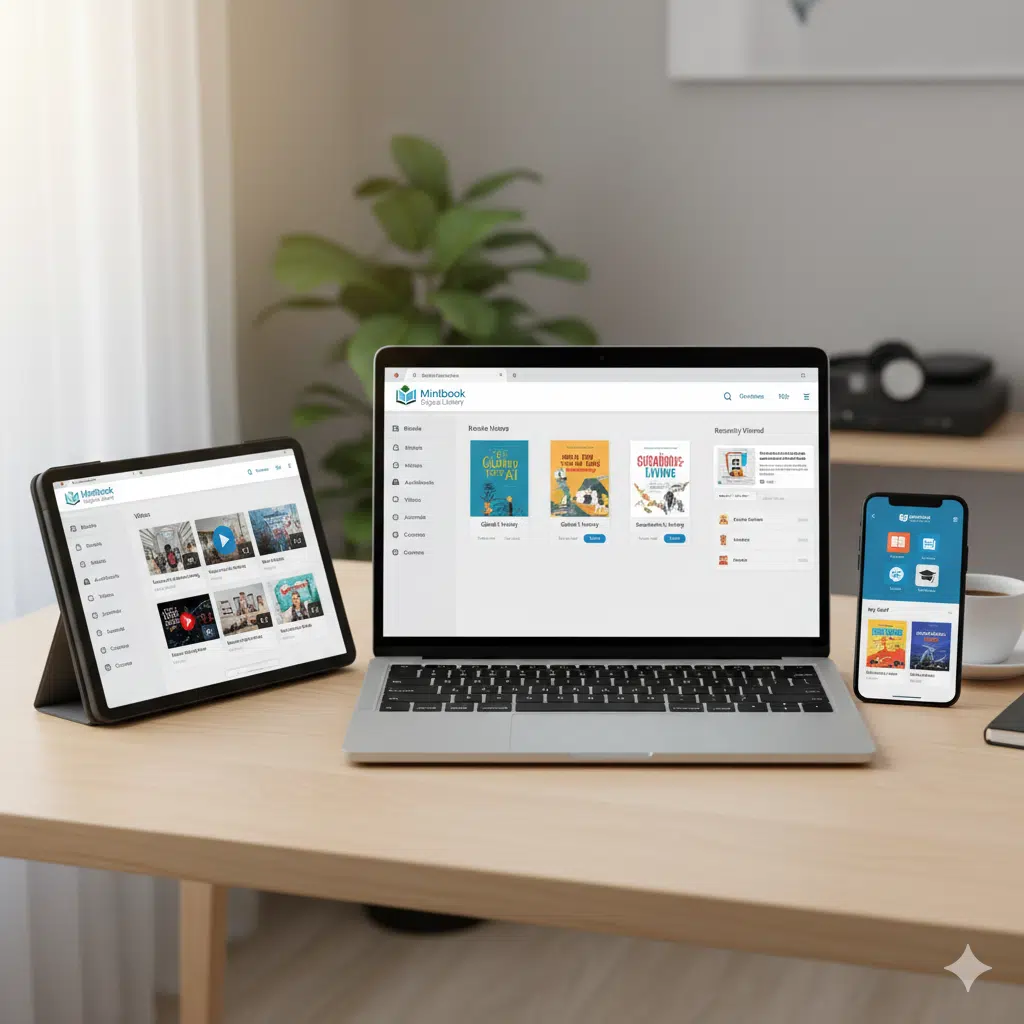
The concept of a digital library has evolved in modern education, extending beyond a mere online book collection. It now serves as a foundation for knowledge access, peer learning, and educational transformation. Mintbook, an AI-driven digital learning ecosystem, exemplifies this shift, bridging technology and education. It redefines digital library functions, effectively catering to the needs of future learners and enhancing their educational experiences.
Digital Library Functions
Digital library functions go beyond simply storing and providing access to electronic books and documents. A modern digital library helps users search, organize, access, and manage educational resources from a single platform. Key functions can include content discovery, advanced search, digital resource management, user access control, reading and learning tools, and usage analytics. These functions make it easier for students, teachers, researchers, and librarians to quickly find and access relevant information whenever they need it.
As digital learning continues to evolve, digital library functions are becoming increasingly integrated with broader learning platforms. Modern systems can support multimedia content, personalized resource recommendations, learner engagement tracking, and integration with learning management systems. For schools, colleges, universities, and other institutions, these capabilities can transform a digital library from a content repository into an integrated learning resource that supports teaching, self-learning, collaboration, and informed decision-making.
1. Accessibility and Resource Aggregation.
Fundamentally, content aggregation is one of the primary functions of the digital library. An excellent digital library should be able to unify such a great number of learning resources, such as e-books, research papers, videos, journals, and interactive resources, under a single virtual roof.
Mintbook is doing well in this area by developing a multi-format content library that is aimed at learners of all fields and age groups. The site has an assortment of:
- Audiobooks and e-books of well-known authors
- Course materials, case studies, and
- Competitive exam question bank and tests
- The materials of skill development were in line with the NEP (National Education Policy).
Mintbook offers learners anytime, anywhere access, thereby making them less geographically and time zone-localized. Its digital accessibility in the cloud makes the conventional library experience a smooth electronic experience.
2. Smart Search and Discovery.
Information retrieval is another important feature of a digital library. With the enormity of the digital resources, it is essential to have the ability to locate the appropriate content as soon as possible in order to promote the productivity of a learner.
Mintbook will blend artificial intelligence search and recommendation approaches, which will assist users in locating what they need within a few seconds. Mintbook intelligent search filters make searching easy, whether a student is researching academic journals, an employee seeking upskilling, or they are preparing for an entrance exam.
The feature enables not only an improved user experience but also an individualized learning journey, which could not be experienced in any way in traditional libraries due to their limited smart search capabilities.
3. Knowledge Organization and Curation.
To any digital library, content management is as crucial as content hosting. Therefore, another important tier of digital library functions is cataloguing, indexing, and classification.
Mintbook involves metadata tagging and category-based organization in the arrangement of learning resources to maintain ease of accessibility. Educational institutions making use of Mintbook are also able to design their own digital library and organize the materials according to the subject, grade, or level of learners.
This organized curation enables institutions to have academic discipline, but gives the learner a leeway to access the resources that may fit their learning objectives.
4. Cooperation and Community Learning.
Conventional libraries have a reputation of being rather quiet places; digital libraries, on the contrary, can make learning a vibrant community. The current digital library operations incorporate social and collaborative technologies, enabling learning and teaching communities to interact, communicate, and exchange information.
Mintbook is not only a content delivery application, but it fosters learning togetherness. Through features like:
- Discussion forums
- Group learning spaces
- Dashboards of gamified
- Peer-to-peer interactions
Mintbook creates a social learning experience instead of a lonely study. Students are able to share, get answers to their questions, and create networks of knowledge all on the same platform.

5. Learning Management Systems (LMS) Integration.
In the case of schools, colleges, and corporate training settings, a digital library has to be aligned with the existing Learning Management Systems (LMS). This is one of the most useful digital library functionalities in the contemporary era.
The Mintbook digital library offers API integrations and LTI support, enabling institutions to connect their LMS systems with the Mintbook content ecosystem. This provides a single learning experience, eliminating the need for users to switch platforms to view both institutional content and the library offered by Mintbook.
This kind of integration enhances the level of engagement, optimizes the learning processes, and facilitates administrative tasks among the trainers and the training managers.
6. Learner Insights and Analytics.
Information is the new blood of education. Analytics and reporting are among the current digital library functions that are no longer indispensable. They enable the teachers to know the interactions of learners in terms of content and assist the institutions in quantifying learning results.
Mintbook uses data-driven insights when analyzing data by using detailed dashboards that follow:
- Student development and
- Time spent on resources
- Patterns of content
- Skill competency levels
Such analytics enable educators and administrators to make well-informed decisions, customize content, and improve teaching approaches. It is a feedback loop that encourages constant betterment among learners.
7. Scalability and Security
With more institutions, there must be more library systems. Another underestimated digital library service is the fact that it is capable of managing a growing number of users and content without compromising data security.
The digital library of Mintbook is constructed upon a cloud-based system that allows supporting thousands of simultaneous users without affecting performance. In addition, the platform uses enterprise-level security measures, which guarantee that the content licensing, copyrights, and user information are safeguarded to the fullest.
This has seen Mintbook become a reliable solution not only for schools and universities but also for corporates and government organizations that are implementing e-learning models.
8. Constant Content Refresh and Inclusion.
An actual digital library is one that keeps on developing. One of the most vibrant digital library functions currently is regular content updates and the inclusion of various resources in the digital library.
To maintain the relevance of its library, Mintbook constantly refreshes the collections of its content with new books, new topics, and learning resources that benefit learners by skill. It is also inclusive as it provides:
- Multilingual materials to address multicultural languages
- Accessibility, e., text-to-speech and font size options.
- Learners with low internet access can also be provided with offline materials
Due to these efforts, Mintbook makes education inclusive, available, and future-oriented.
In Conclusion: Mintbook -Powering the Future of Digital Libraries
Digital libraries have evolved from static repositories to dynamic systems that support lifelong learning and interactive experiences. Mintbook embodies this evolution, integrating AI, analytics, and collaboration tools to reshape education for institutions, corporates, and learners. This all-in-one platform enhances accessibility and interaction, exemplifying innovative education. Mintbook represents not just a library, but the future of knowledge in a digital landscape.
