


Our access and consumption of information, and the way we handle it, are changing quickly. The old libraries, which were characterized by rows of books and reading rooms, have already moved into the digital platforms. However, today, we are entering a new, higher stage, the emergence of the AI digital library. They are not mere content repositories but smart ecosystems that are meant to provide personalized, effective, and highly relevant learning experiences.
With technologies such as AI search, semantic search, and advanced knowledge management systems, the digital library’s future is being influenced by the needs of modern learners as institutions adapt to their needs. Combined, they are turning digital libraries into smart and powerful libraries that do not just store information but are dynamic knowledge centers.
From Static Archives to Intelligent Systems
Access was one of the biggest issues that were solved by traditional digital libraries. They put books, journals, and academic resources at their fingertips from any place. Nevertheless, they continued to be heavy users of manual search, matching with keywords, and user-intensive.
This is where AI comes in.
An AI digital library has knowledge of user intent. It does not simply match keywords, but context, behavior, and preferences are interpreted. This implies that the users no longer need to filter through the innumerable search results. The system provides them with precisely what they need- sometimes even before they can realize that they need it.
The Power of AI Search and Semantic Search
AI search and semantic search are at the core of this transformation.
As opposed to conventional search engines, semantic search is more concerned with meaning and not the actual words. To illustrate, a student needs to search for something like the effects of climate change on agriculture, a semantic engine will have a broader understanding and will find related research articles, case studies, and reports, though not necessarily with the exact phrase used.
Such a level of intelligence makes learning quick, more natural, and much more efficient.
Artificial intelligence search evolves, too. It will take in the interactions of users, what they will click, read, save, or disregard, and it will keep on learning. This generates a unique experience for all learners, educators, and researchers.

Personalized Learning Experiences
Personalization is one of the most thrilling facets of the digital library future.
The contemporary learner wants to see platforms conform to their desires, as streaming services or e-commerce platforms do. This can be achieved in digital libraries through AI by:
- Prescription of content on the basis of learning patterns.
- Recommending related issues to learn more.
- Creating reading lists that are goal-oriented.
- Giving intelligent briefs to get faster answers.
This changes libraries into partners of learning and not passive resources.
Enhancing Knowledge Management for Institutions
In the case of institutions, digital libraries are not merely about accessing content, but are also important tools that aid in managing knowledge.
The AI-driven systems assist in organizing, categorizing, and linking large volumes of data between departments. It makes academic material, research articles, internal documents, and training material searchable, organized, and interrelated.
This leads to:
- Increased interaction between students and faculty.
- Swift research and innovation.
- Efficient content utilization
- Less wastage of resources.
Essentially, smart libraries are central knowledge systems that facilitate learning and institutional development.
Smart Libraries: Beyond Books
The idea of smart libraries goes much further than the digitization of books. These platforms are combined with several tools to form a comprehensive knowledge experience:
- AI-driven content discovery
- Interactive learning modules
- Integration of multimedia (videos, audio, infographics).
- Live data analytics and usage.
- Mobile-first accessibility
These libraries are aimed at the modern-day learners- they like interactive, on-demand, and engaging content.
Bridging the Gap Between Technology and Education
With the implementation of hybrid and online learning systems in educational institutions, the necessity of smart content systems becomes even more urgent. The AI digital library fills this gap by harmonizing technology with pedagogy.
It helps teachers in the following ways:
- Assisting them in selecting teaching resources.
- Monitoring student activity and achievement.
- Providing an insight into the gaps in learning.
To students, it makes quality, curated knowledge, anywhere, anytime.
The Role of Mintbook in Shaping the Future
Here, Mintbook is in the lead in innovation.
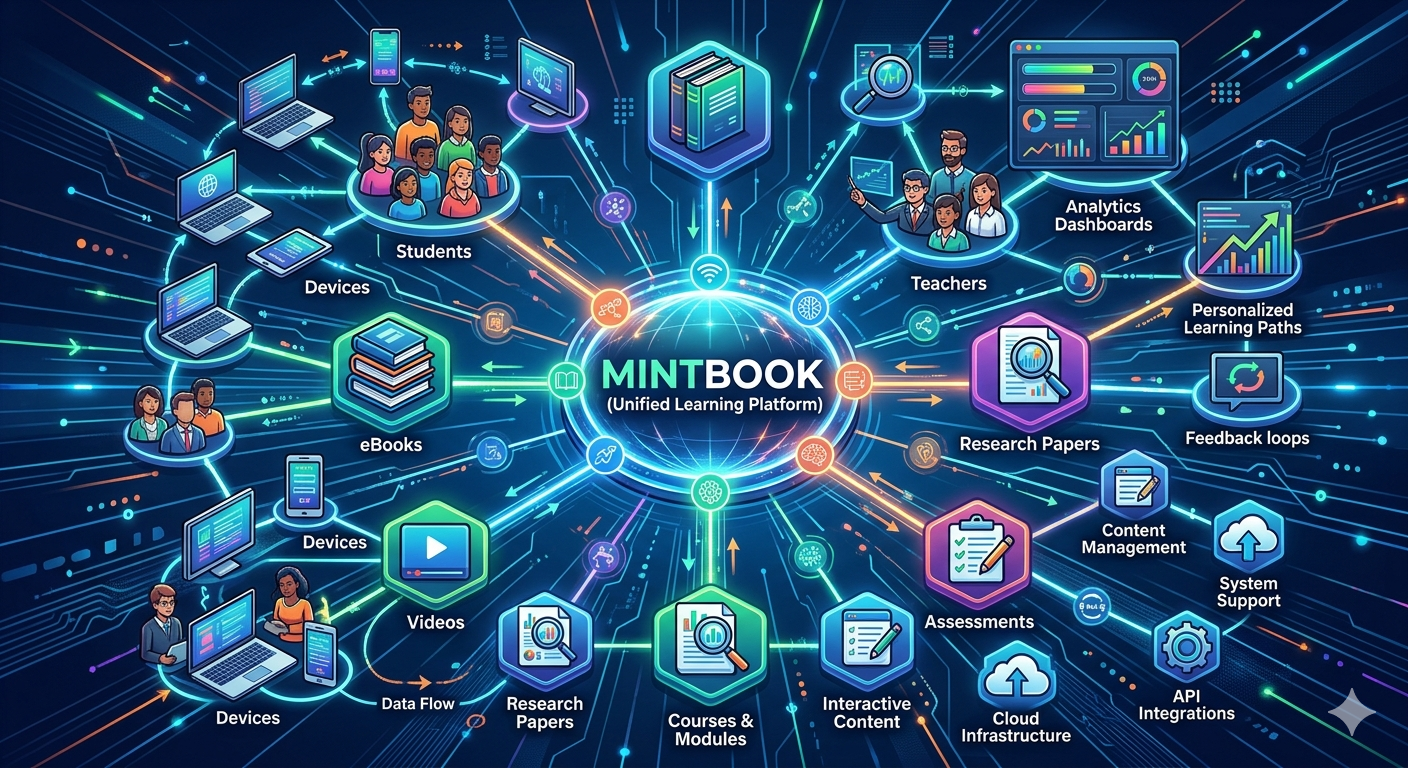
Mintbook is reimagining the notion of digital libraries by creating high-tech, AI-driven knowledge platforms that play to the needs of present-day institutions. Its solutions extend beyond conventional content management to provide truly smart libraries that are easily navigable, scalable, and future-ready.
With the services at Mintbook, institutions are able to:
- Install a powerful AI digital library, where the curated content is easily accessed.
- Take advantage of smart AI search and semantic search to make a specific discovery.
- Enhance interdepartmental knowledge management.
- Offer individualized learning to students and teachers.
- Get access to a vast amount of digital materials, such as eBooks, journals, and multimedia information.
The platform of Mintbook is created with the purpose of keeping pace with the changing educational requirements so that institutions remain on top of the fast-evolving digital environment.
Looking Ahead
Libraries no longer have a future that is physical or static; it is about intelligent, adaptive ecosystems that enable users to access the knowledge they require at the appropriate time.
With the further development of AI, the trends of the digital library in the future will be more personalized, predictive learning, and more integrated with academic processes. Colleges and universities that adapt to this change in the present day will be in a position to foster innovation, creativity, and lifelong learning.
Final Thoughts
The shift of the conventional libraries to AI digital library systems can be seen as a great leap in accessing and using knowledge. Libraries are turning into smarter, faster, and more user-friendly with technologies such as AI search, semantic search, and advanced knowledge management.
Investing in smart libraries is no longer a choice, but a necessity, especially for institutions that want to remain relevant and competitive.
Are you willing to make your institution future-ready in terms of knowledge?
Find out the AI-based digital library solutions of Mintbook today and make the first steps to create an intelligent, scalable, and effective learning ecosystem.
