

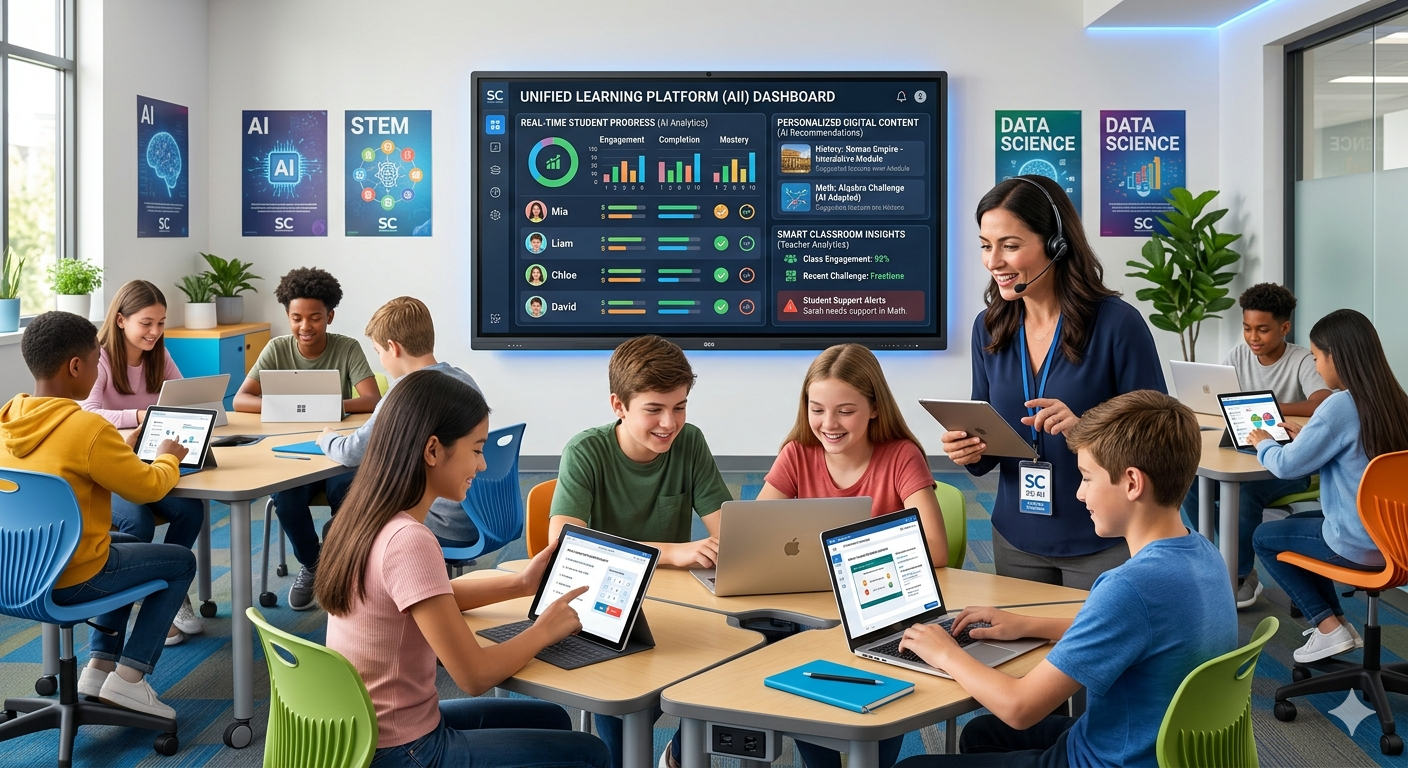
Education is no longer restricted to classrooms, books, and even solitary electronic devices. With the world becoming more connected, intelligent, and learning becoming seamless, personalized, and data-driven, schools and institutions are on the verge of transitioning to a more connected ecosystem in 2026. The key to this change is the idea of a single learning platform that is being driven by the incorporation of AI, LMS, and digital libraries.
However, what does this simply imply for teachers, learners, and schools? And why is this combination coming to be necessary and not optional?
Let’s explore.
The Evolution of Learning Systems
Schools have long been using individual tools to address the various needs of a Learning Management System (LMS) to deliver courses, digital libraries to access content, and analytics tools to monitor performance. Although each has its purpose, they are not very easily integrated, and this may cause a fragmented learning experience.
Students leap up among platforms. Teachers are not able to cope with unrelated information. Administrators face inefficiencies.
This is where the AI LMS model of digital library makes a difference in the game.
It does not make individual systems, but a single ecosystem in which:
- There is co-existence of content, assessments, and analytics.
- AI improves decision-making and personalization.
- There is continuity, not compartmentalization, in learning.
What is Unified Learning Platform?
A unified learning platform is a platform that involves three key elements:
- Learning Management System (LMS) – to deliver the course, assessments, and monitoring.
- Digital Library – to an enormous and edited collection of scholarly resources.
- Artificial Intelligence (AI) – to personalize, automate, and gain insights.
When these components are put into play, the outcome is a harmonious and intelligent learning atmosphere that becomes accommodating to the needs of each learner.

How AI Enhances LMS and Digital Libraries
The AI is the foundation that enhances conventional systems into intelligent ecosystems. It looks like this boosts the experience:
1. Personalized Learning Paths
Using AI, student behavior, performance, and preferences are analyzed, and custom learning journeys are suggested. There is no common way of learning among two students, and now, they do not need to.
2. Smart Content Discovery
In an AI LMS online library, the students will not have to endlessly search. AI recommends pertinent books, videos and other resources, depending on their curriculum and gaps in learning.
3. Automated Assessments & Feedback
The AI-based grading and instant feedback systems save teachers time and enable them to spend more time on their teaching and mentoring.
4. Predictive Analytics
AI can recognize students who are possibly falling behind and warn the educators about it, allowing them to intervene in a timely manner.
5. Adaptive Learning Experiences
The difficulty of content is dynamically adjusted according to the performance of the students, making sure that they are engaged and retained.
Why Schools Need a Unified Learning Platform in 2026
Education is in a state of rapid change and is being digitalized as well as influenced by policy changes. Those institutions that are still using isolated tools are at risk of being left behind.
This is why it is important to use a single learning platform:
- Fluid Learning Process: Students can access all things, like lessons and all resources, in a single location.
- More efficient Teachers: Less administrative duties and more teaching.
- Data-Driven Decisions: Live information on student gains and performance of the institution.
- Scalability: Easy to be flexible to expand institutions and change curricula.
- Future-Ready: Conforms to the current education standards and digital-first approaches to learning.
The Role of Digital Libraries in This Ecosystem
Digital libraries are no longer merely a repository of eBooks. They are transformed into dynamic learning centers in a single system.
Being a part of an AI LMS digital library, they provide:
- Curriculum-aligned content
- Multimedia learning materials (video and audio, interactive modules)
- Accessibility and up-to-date information.
- AI-powered recommendations
This will make sure that the students are not merely passing the information through their mouths- they are actually learning it.
Bridging the Gap Between Technology and Learning
The introduction of technology without a deluge to the users is one of the biggest challenges institutions have. A disjointed system can result in low adoption rates.
This is addressed by having a single learning platform that:
- Offering a single interface and a login.
- Making navigation easier for students and teachers.
- Bringing together all the tools in a single ecosystem.
- Lessening the complexity of training and operations.
The result? Increased participation, increased results, and an improved digital change process.

How Mintbook is Powering the Future of Learning
With institutions shifting towards smarter education ecosystems Mintbook is leading the pack.
Mintbook solutions aim to work together to blend LMS features with the advanced digital library platform, augmented with AI to build the ultimate single learning platform.
With Mintbook, the institutions can:
- Gain entry to an all-encompassing AI LMS web-based library, based on their curriculum.
- Provide customized learning with insights into AI.
- Make digital content of high quality and accessible 24/7 to the students.
- Give teachers intelligent teaching, evaluation, and analytics tools.
- Have a scalable, secure, and future-ready learning infrastructure.
Mintbook is not simply a technology, but a whole learning ecosystem that is flexible to the demands of 21st-century education.
The Future is Unified
The move to an integrated learning platform is not only a trend, but it is the future of education. With the further development of AI, the process of LMS and digital libraries integration will be even smarter, more intuitive, and effective.
Successful institutions in 2026 and onwards will be those that:
- Adopt an integrative as opposed to fragmented.
- Smart learning with the help of AI.
- Offer students and educators smooth and interactive experiences.
Final Thoughts
A massive change in education is being witnessed. The integration of AI, LMS, and digital libraries is changing the nature of knowledge delivery, consumption, and application.
The presence of a strong AI LMS digital library on a singular learning platform means that learning is not merely digital- it is intelligent, tailored to individuals, and is future-proof.
Willing to Change Your Institution?
The unified learning solutions of Mintbook can take you a step ahead in the future of education. Revitalize your students, empower your teachers, and create a smarter learning ecosystem today.
Get to know the offerings of Mintbook and make a first step towards an entirely integrated learning experience.
