


Education is an industry that is changing at a high rate. Classrooms are never simply four walls, and learning is no longer through textbooks and immobile modules. With the adoption of digital platforms in institutions and organizations, the question that still arises is, why is eLearning still so stiff and impersonal?
Regardless of huge investments in platforms and content, most systems do not provide really engaging and adaptive learning. The missing ingredient is the most important one: AI in eLearning.
The Problem with Static Learning
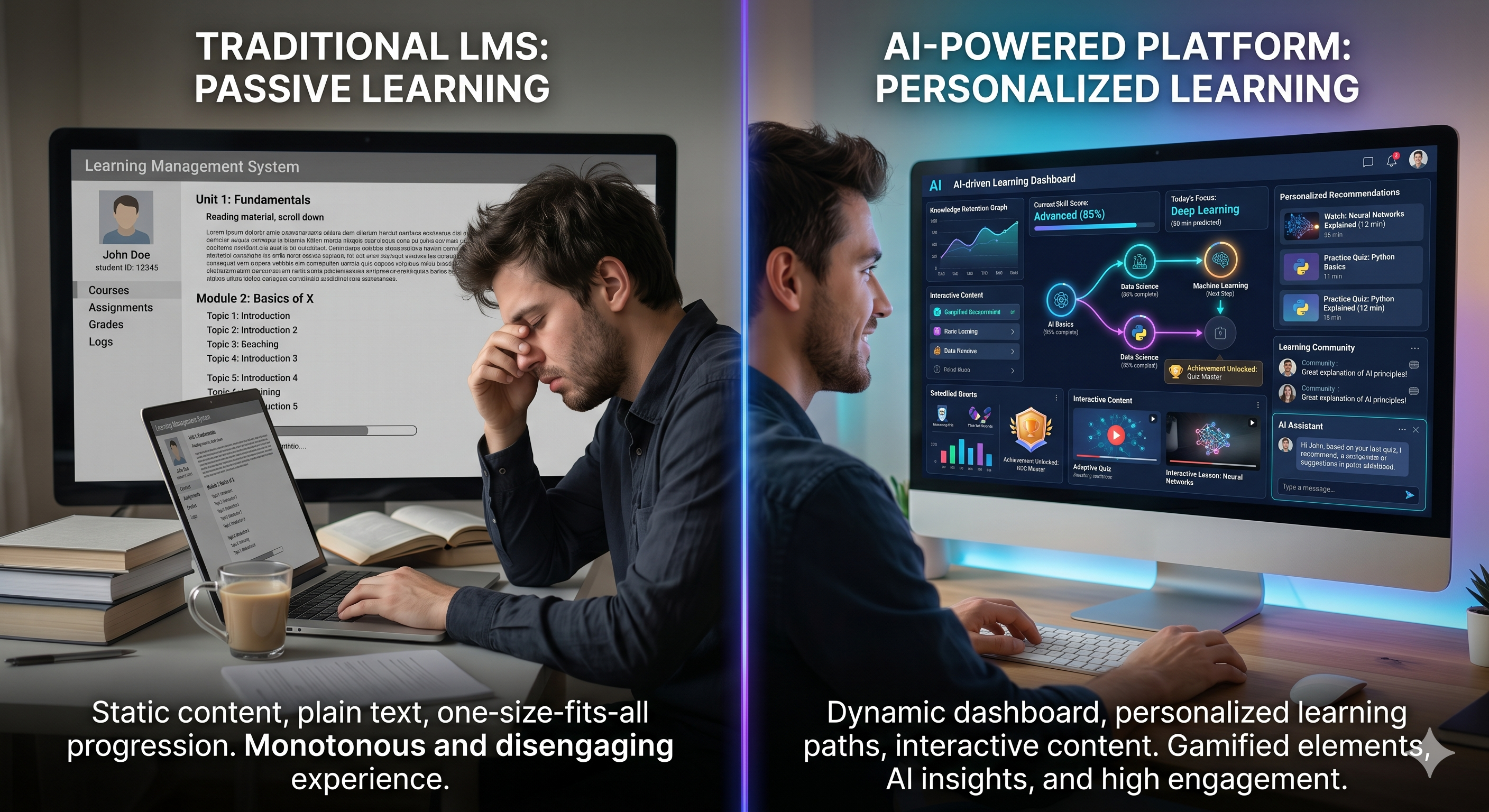
The old digital educational platforms were constructed to digitalize as opposed to personalizing content. Although Learning Management Systems (LMS) made the content available, they usually copied the very one-size-fits-all model that was observed in the traditional classrooms.
This is where the LMS system’s traditional limitations are observed:
- Pre-determined learning tracks that do not adjust to personal needs.
- Insufficient real-time feedback and insights.
- Minimal learner engagement
- No individual or forecasted learning paths.
Concisely, they provide content- but not intelligence.
Learners are no longer content with access, but they require relevance. And this is where AI comes in.
AI in eLearning: A Shift from Delivery to Intelligence
The use of AI in eLearning is not a fad; it is a paradigm shift. Rather than merely hosting material, AI-driven systems note, modify, and improve the learning experience in real time.
The following is the way AI is changing eLearning:
-
Personalized Learning Paths
AI examines the behavior, performance, and preferences of learners to design personal learning experiences. There are no two learners who embark on the same course, and this makes learning more efficient and interesting.
-
Intelligent Content Recommendations
Similar to Netflix, AI recommends the appropriate learning materials at the appropriate time. This will keep the learners interested and keep them moving.
-
Real-Time Feedback & Assessment
AI tools can offer immediate feedback to learners, meaning that they can quickly recognize the gaps rather than after evaluations.
-
Predictive Analytics
AI has the ability to anticipate student results and those who are at risk of underachievement, to allow interventions.
-
Automation of Administrative Tasks
In grading and reporting, AI will help lessen the amount of manual labour, enabling teachers to concentrate on what is actually important: teaching.
The Future of eLearning: Smart, Adaptive, and Scalable
The future of eLearning is intelligent ecosystems that will develop with learners. The institutions are no longer seeking platforms that simply store the content, but rather systems that comprehend learners.
With the increasing use of the digital world, particularly in the school and higher education sectors, AI will take center stage in determining the outcome of learning. It comes in between the technology and pedagogy, and as a result, education:
- More engaging
- More inclusive
- More outcome-driven
It is particularly important in the reality of digital transformation education when a goal of the institutions is not merely to modernize infrastructure, but the very learning experience.
AI Learning Tools: Beyond Automation
It is believed that AI learning tools are only about automation. They, in fact, are concerned with augmentation – improving human abilities.
AI is a co-pilot to educators:
- Suggesting content improvements
- Giving information on student performance.
- Enabling data-driven decision-making
In the case of learners, AI turns out to be a guide:
- Offering personalized support
- To keep up with the times and fashion.
- Enhancing learning by making it interactive and immersive.
This change puts learning as a passive consumption into an active participation.
Bridging the Gap with Mintbook
The opportunities of AI are gigantic; however, its practical implementation will be determined by the extent to which it is embraced in the learning world. This is where Mintbook will shine.
Mintbook is not only a digital content provider but also a full-fledged solution that will drive the future of learning.
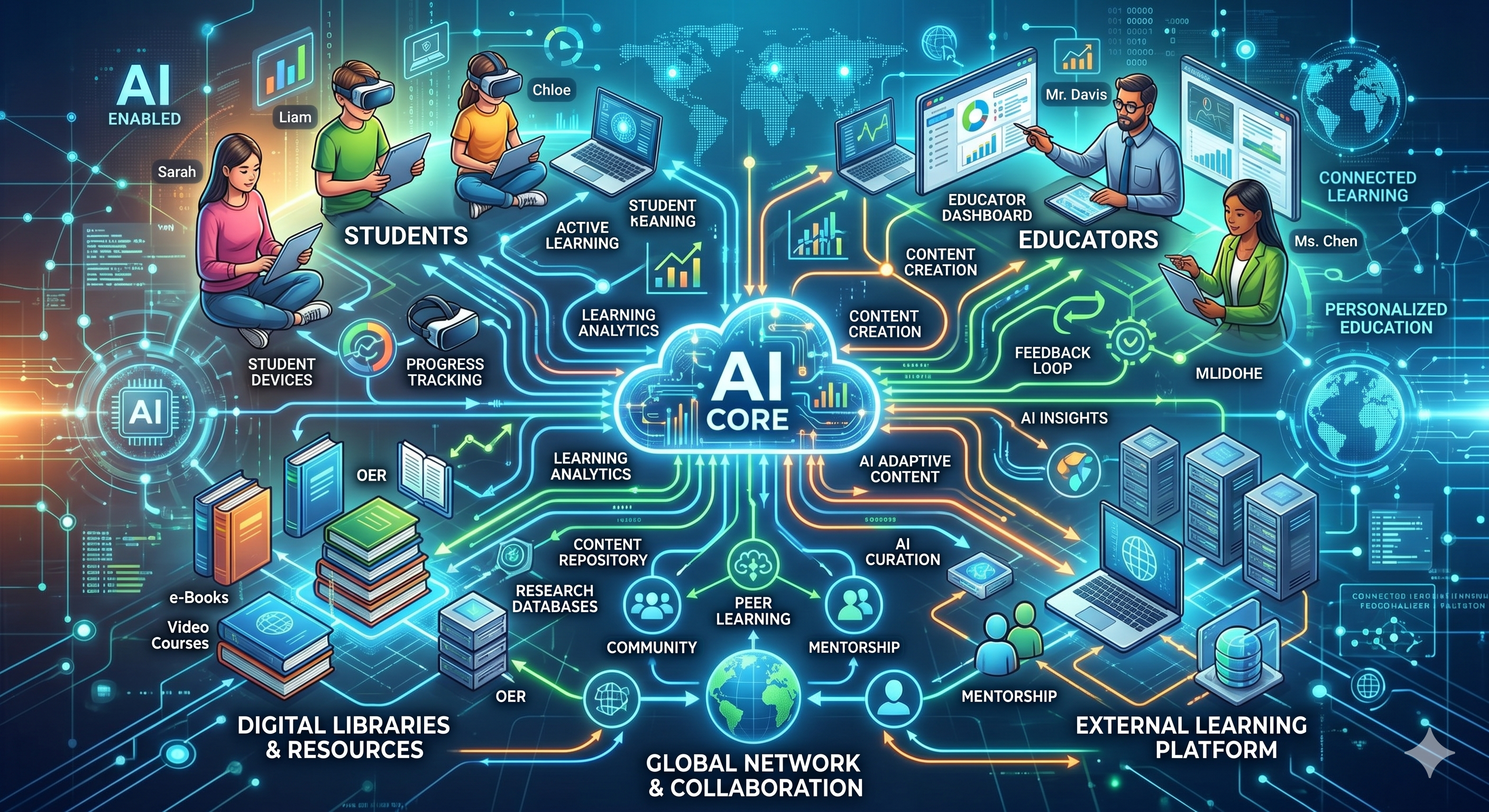
Mintbook assists organizations in making the shift to the smart learning environment by integrating digital libraries, LMS features, and AI-powered insights.
This is the way Mintbook will effect this change:
-
Unified Learning Ecosystem
Mintbook is a combination of digital libraries and a learning platform, so learners can access high-quality and curated resources in a single location.
-
AI-Driven Learning Experience
Using intelligent suggestions and analytics, Mintbook is in line with the rising requirement of AI in eLearning, and learning can be more personalized and more effective.
-
Addressing Traditional LMS Limitations
In contrast to traditional systems, Mintbook is engagement-oriented, flexible, and usable, addressing major limitations of traditional LMS.
-
Scalable for Institutions of All Sizes
It could be a school, college, or organization, but the solutions provided by Mintbook will easily scale.=
-
Supporting Digital Transformation in Education
Mintbook is crucial to supporting a digital transformation in education, as it assists institutions in future-proofing their learning strategies.
Why AI is the Missing Layer
eLearning cannot be complete without AI. It is like a library without a librarian or a map without directions.
AI brings:
- Context to content
- Intelligence to delivery
- Personalization to scale
It turns learning into a process as opposed to being a static one.
Those institutions that do not embrace AI do so at a risk of falling behind the times, not only technologically, but in relation to pedagogy as well.
The Road Ahead
Education is no exception to the introduction of AI, and it is happening. The expectations of learners will also keep on changing as they become more digitally native.
Whether to implement AI or not is not the question, but how fast and efficiently this process can take place.
Solutions putting all the content, technology, and intelligence within a single experience are already being blazed by platforms such as Mintbook.
Final Thoughts
The move towards smart learning, rather than a technological upgrade, is more than a technological upgrade, and it is a paradigm shift in teaching and learning.
Through adopting AI in eLearning, institutions will be able to access:
- Better learner engagement
- Improved outcomes
- Scalable education models
The future of eLearning lies with the people who do not focus on content but are ready to be smart.
It is high time to consider smarter solutions to turn your learning ecosystem and break the traditional LMS boundaries.
Ready to reinvent learning for the digital age?
Learn how Mintbook can assist you in being an integrator of AI learning tools and guide your institution through the actual digital transformation of education.
Get in touch with Mintbook and create a more intelligent, flexible learning experience tomorrow.
